Showing posts with label Inspirations Design Studio. Show all posts

Saturday, October 20, 2012

I Spy with my Little Eye...

...all things kitchen and bath related! Seriously, everywhere I go I notice, I critique and sometimes I take pictures just for proof of how wonderful or terrible something is I come across.

It's funny how our individual careers are just one more reason we all see the world so differently. Take my friend Jackie for example, she's the international sales manager for CaseMate, which is a company that designs and manufactures fashion accessories for smart phones. Everywhere we go she's noticing phone cases, ipad covers, screen protectors, etc... She can take one look at a phone and spit out the make and model. Even more, she will literally take the case off her own phone(the technological equivalent of taking the shirt off your own back) without thinking twice if she sees someone with a sub-par case. She's the real deal and she sees the world with cases on the brain. So here she is noticing phone cases, and here I am noticing cabinetry and tile, both living in our own happy bubble where we notice things we love and are passionate about.

While all design related items grab my attention it's cabinetry that really makes me look twice. To me, the cabinets really define a space, not only layout wise but style wise as well. Cabinets come in all shapes, sizes, colors and wood species, but it's the actual construction of the cabinet that I want to talk about today. There are two basic types of cabinetry construction - Framed & Frameless with the main differences between these two being aesthetics and accessibility.

So, let's dig in......

Framed Cabinetry:

Inset Cabinetry:
Inset Cabinetry is the creme' de la creme' of framed cabinetry....


This project is from the 2011 FoxHall Show House.
Cabinetry is Bell Custom.
Above is an example of inset cabinetry. Notice how the door sits within the face frame of the cabinet, creating very clean lines.


This is another shot of an inset cabinet, but this example showcases a bead around the opening of the cabinet.


Follow my ghostly white hand to the bead I'm referring to.
Inset cabinetry is the most expensive cabinetry construction. The expense comes from the skill required to build doors and drawer fronts that fit snuggly between the rails and stiles of the face frame. At the end of the day the door either fits in the opening or it doesn't, and there is very little room for adjustment, ergo the expense. This type of cabinetry construction hearkens back to the furniture craft which is what gives these cabinets that timeless look.

Overlay Cabinetry:
Overlay cabinetry is another type of framed cabinetry construction and probably what most people have in their homes.
The above cabinet is on display here in my office at Inspirations Design Studio and showcases a partial overlay cabinet ( 1/2" overlay to be exact.) Notice how the door sits on top of the cabinet box.


My ghostly white hand is back and is pointing to the cabinet box in which the door is sitting atop of. This type of cabinetry construction is referred to as a partial overlay because that 1/2" is showing on either side of the door.


This cabinet is an example of a full overlay cabinet. Full overlay is still in the framed cabinet family but is different from 1/2" overlay in that the door takes up nearly the entire face frame with very little exposed face frame on either side of the door...see below...


Full overlay cabinetry is going to give you more seamless look, where you will be seeing far more of the actual door than you will of the face frame of the cabinet box.

Framed cabinetry, regardless of the specific type (inset, partial overlay or full overlay) is a traditional American method of cabinetry construction. While the different types of framed cabinetry vary aesthetically they have accessibility in common, but let's talk more about that after we go over frameless cabinetry.
Frameless Cabinetry:


Frameless cabinetry is also known as European style cabinetry. The cabinets are constructed where the door sits directly on top of the cabinet box, creating a very sleek and seamless look as seen below.
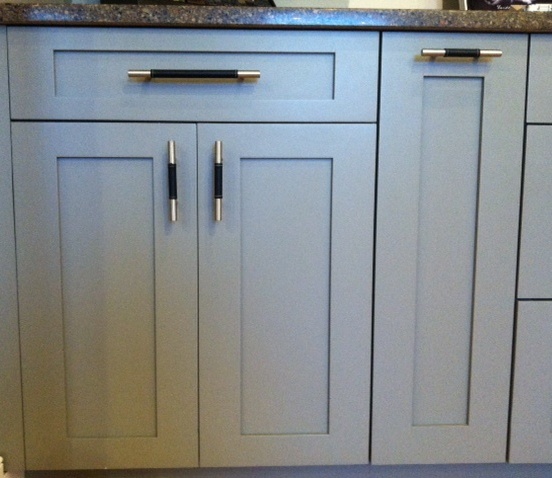

Remember this little guy from my facelift series a few months ago?? He's frameless too!

Photo my own. 

Notice in both pictures above all that you see are the cabinet doors, there is no face frame showing. While both cabinets have a shaker style door, please know this type of cabinetry construction can be done with both traditional and contemporary door styles as well.

One of the main advantages to frameless cabinetry is the accessibility. Unlike framed cabinetry, there is no inside edge of a frame that is partially blocking the perimeter of the cabinet opening. Frameless drawers are also larger because the framed cabinet drawers have to be made smaller to fit through the face frame opening. 


Above is an example of the full access you get with frameless cabinetry. Are you acquiring an abundance of extra space? No, but every little bit counts especially in rooms where storage space is slim.

The price of frameless cabinetry can really fluctuate depending on where you purchase the cabinetry. Because a lot of American based cabinet makers have their machines set up to make framed cabinets, many of them do not offer frameless and if they do it can be expensive. However, other companies like the one I work for offer both frameless and the 1/2" overlay cabinetry and both are priced the same. 

Here is the typical  cabinetry construction price break down from highest to lowest:


  • Inset
  • Frameless/Full Overlay (Framed)
  • Partial Overlay
Well, there you have it, now you too will be noticing cabinetry construction every time you come across a cabinet! Now that you know the differences you will have to try and spot the various construction types and get your hands and eyes on them to see which construction style you prefer. I hope that your new found knowledge also helps you in future kitchen and bath endeavours. With the long list of decisions one has to make as they prepare to start a kitchen or bath project, I always suggest starting with the construction of the cabinetry. This decision will define not only the look you are going for, but also the price point.

Unless otherwise noted all photos were taken from the Inspirations Design Studio showroom.

Tuesday, July 3, 2012

Size Matters

Have you ever walked into a room and instantly loved it for so many reasons, none of which you can put your finger on? This has happened to me countless times. Some houses, rooms, spaces, even outfits just work and while the how is unclear, the fact is, design magic has happened.

There are several factors that come together to spark design magic, but one of the most important of those is scale. Scale is as important to design, as cheese is to cheese dip. Dead serious. Scale is one of those silent components that can really make or break a room.

Scale is the size relationship from one object to another.

Scale comes into play a lot in design. From the way you decorate your mantle, to the cabinets you choose to put on the same wall as your oven, to the pieces of art you choose for both large and small walls in your home. Scale is relevant everywhere.

Let's start with scale gone wrong.

This blog has been a long time coming. The final straw/slap in the face inspiration came while I was in Chicago in April, for the KBIS show.

This photo is my own.
THIS is my hotel room, and that tiny spec you see on the wall is not a cockroach, it's art. The only art on the entire wall. I mean, obviously they're trying (dear God, let's hope) to make some kind of understated design statement by choosing this size art for this size room, but I don't get it. All I see is a whole lot of wall and I'm bored.


It's hard for me to be negative about this room, I mean it has a COW RUG for crying out loud. But, alas I must critique. The scale in this room is off, specifically on the back wall. The frame and accessories used  are far too small to carry off this large wall. A collection of three frames that size over the bed would have worked much better. Also, I would group the gold candle stick holders together instead of having them flank anything. Sometimes too much matchy-matchy balance can be just as bad.


The one picture featured on this wall is WAY to small. While the white space around the fireplace is not vast, the picture still gets lost on the wall around it.


This Kitchen has good and bad scale. The cabinetry scale in this kitchen is good. The cabinets have good symmetry and the variation of depth add interest. The window however, kills the whole thing. While I like the window in general it is far too small to be located where it is with nothing on either side of it. The window  should either be bigger or they should have incorporated more wall cabinets on each side.

Scale done Right.

This room has great scale.There is a lot going on in this room but everything balances, and does so without trying too hard. There are some matchy-matchy elements like the fur ottomans (love), but then other items like the lamps balance without being identical. Another big plus is the mirror, notice the width and height are appropriate for the location within the space. Due to the scale and symmetry, this room feels complete.


While some might find this space really cluttered, I find it fun and unique. Notice that the walls to either side of the fireplace are not equal. The right side is much larger than the left. While this fact could seriously derail some, whoever designed this space brilliantly decorated these walls in such a way that your eye probably doesn't even notice the two walls aren't the same until you look closely. I'm also loving the mixture of shapes, sizes and materials. On the fireplace wall alone we have large mirrored circles, a small round frame, and three varying sized rectangular frames. The mixing of these elements gives the room depth. Depth AND Scale... Home run, every time.


CLAPPING!!!!!!!! This is scale done right, right here. This Kitchen was in the Atlanta Homes & Lifestyle's 2010 Christmas House and was designed by Mike Bell of Inspirations Design Studio. While this kitchen looks vast, it is only 200 square feet. Because the space was small, scale was very important. As you can see all cabinetry goes to the ceiling, but glass cabinets were cleverly used at the top to make the space appear taller. This kitchen is very symmetrical and it's clear a lot of attention was paid to scale, which is one of the main reasons this space is so pleasing to the eye.

As you can see, scale is very important and something to really consider when investing in your space. Scale can truly make the difference in a "ho hum" space and a great space. You want your space to feel complete, not like a piece is missing. I'd rather see a completely blank wall than a wall with two dinky frames floating in the middle, giving the impression there was a BOGO (buy one get one) sale at Hobby Lobby. Don't get me wrong, I'm not knocking Hobby Lobby, you can find all kinds of treasures there. But at the end of the day it's about considering the size of the space you're accessorizing in relation to the size of the accessory you are looking to buy.

Unless otherwise noted all photos are from google search.